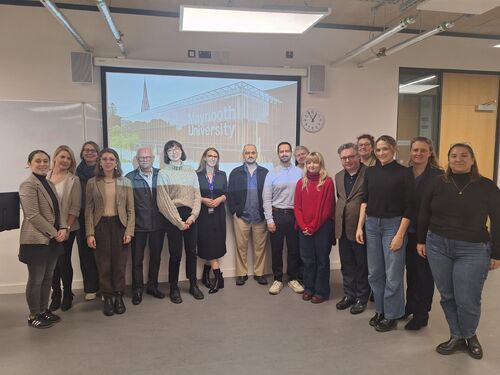
The INOU were delighted to contribute to ESF Social Innovation+ BRIDGES Project, in attending a project partner visit in Maynooth University.
BRIDGES aims to adapt and transfer elements of successfully tested approaches to meet the specific needs of people in long-term unemployment, identified in the regions of Berlin, Vienna, Bologna and Dublin.
BRIDGES builds upon systematic transnational exchange and peer learning: by fostering continuous mutual learning among organisations, staff, and through communities of practice, innovative employment measures will be tailored to local contexts. Participation of civil society actors and building new relationships between public, private and third sector entities will generate an input of improved services and policies.
The pilots will be based upon previous experiences but integrated with the most suitable elements to address specific local needs, like the integration of persons with disabilities and health issues, younger long-term unemployed people and women. The results will be part of a deep and wide program of capitalisation, capacity building and policy practice dialogue, fostering further mainstreaming, transfer and scalability of the social innovations tested. The project partners based in Ireland are Ballymun Job Centre and Maynooth University.
Expected results:
- Support 60 to 100 long-term unemployed (LTU) individuals across Ireland, Germany, Austria, and Italy through tailored pre-employment and subsidised employment pathways, with a focus on vulnerable subgroups such as people with disabilities or health issues, women with caregiving responsibilities, and at-risk youth.
- Train 40 employment coaches and 40 company mentors to provide person-centred support before, during, and after job placements.
- Engage 40 to 60 local organisations and employment providers in the design and delivery of inclusive labour market interventions.
The INOU attended the social partners visit to provide an insight into the practices and challenges for inclusive labour market practices in Ireland. Alongside colleagues, we emphasised the importance of integrated guidance approaches in supporting people along their pathway to work and fostering career development skills. Dr Nuala Whelan presented the MEEG (Model of Enabling Employment Guidance) toolkit, and we discussed the importance of careful activation when working with people in long-term unemployment. We look forward to hearing how this project develops, and the international experiences in developing these employment pathways.