Today, 20th August 2026, the CSO published the Labour Force Survey (LFS) for Quarter 2 2026, which covers the months of April-June.
The Labour Force Survey (LFS) is a continuous household survey carried out by the Central Statistics Office (CSO) and is the official source for employment and unemployment estimates in Ireland.
Unemployment
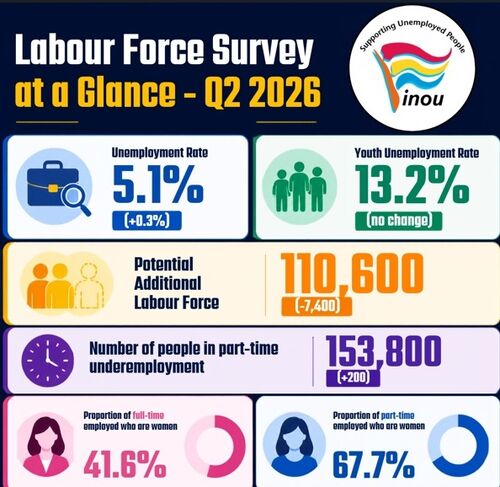
In this quarter 151,000 people were unemployed, an increase of 10,100 (7.2%) from the same Quarter in 2025. The unemployment rate in 2026 was 5.1%, an increase of 0.3 percentage points (ppts) over the year.
The unemployment rate for women was 5.2%, an increase of 0.7 ppts from 2025. The unemployment rate for men was 5.0%, remaining the same from Quarter 1 2025. Women accounted for 48.3% of the unemployed in 2025.
The unemployment rate for young people aged 15-24 years was 13.2%, unchanged from Q2 2025. The unemployment rate for people aged 25-74 years olds was 3.9%, an increase of 0.3 ppts from Quarter 2 2025. Young people accounted for 32.3% of the unemployed in Quarter 2 2026, a decrease of 2.9 ppts.
The number of people deemed long-term unemployed (over one year) increased by 0.2 percentage points over the year to 1.3%, amounting to 38,900 people. Women accounted for 48.9% of the long-term unemployed in 2026, an increase of 7.8ppts compared to Quarter 2 2025.
The Potential Additional Labour Force
The Potential Additional Labour Force (PALF) captures people who may not fit into the official definition of unemployment, whereby people have to be actively seeking work for the previous four weeks and available to take up work in the coming two weeks of the survey. The total PALF of 110,600 is down from 118,000 in Q2 2025.
The CSO noted that “Of those who stated that they wanted to work but were not seeking work or available for work in Q2 2026, 30.0% said this was due to education or training. This compares to 32.1% a year earlier. Persons not seeking work due to own illness or disability accounted for 30.6% of the total in Q2 2026, up from 27.3% in Q2 2025.”
Employment Figures
Over the year the number of people employed in Ireland increased by 0.8%; 2,839,300 people were in employment. The employment rate is 74.3%, an increase of 0.8 percentage points over the year. Full-time employment increased by 0.6% to 2,249,600 people, accounting for 79.2% of those in employment. Women accounted for 41.6% of people in full-time employment in Quarter 2 2026, 0.1 percentage points higher than in 2025.
Over the year part-time employment increased by 7,600 people to 589,600: within this figure, part-time underemployment slightly increased by 200 to 153,800 people. In 2026 women accounted for 67.7% of people in part-time employment, and 62.8% of people who were underemployed.
The Labour Force
Over the year the Labour Force rose by 1.1% to 2,990,200 people. The labour force consists of people who are in employment plus people who are unemployed. Two factors influence changes in the Labour Force: the demographic effect (+37,000) and the participatory effect (-5,700).
The participation rate in 2026 is 66.0, a decrease of 0.4 ppts from Q2 2025. The participation rate measures the share of the total population aged 15 years and over who are in the labour force. Over the year the participation rate decreased by 0.8 ppts to 70.8% for men and for women remained stable at 61.3%.
************************************